

After hitting new highs the previous week, stocks pulled back last week as long-term interest rates continued to march higher. The big story was the 30-year Treasury yield hitting levels last seen in 2007, leaving the S&P 500 down about 2% from its recent highs and worrying many that higher yields could eventually weigh on the bull market, while gold and other commodities surged.
If there was a common thread to the week, it was debt. US government debt crossed the $40 trillion mark, just nine years after hitting $20 trillion. And the artificial intelligence buildout—until recently funded almost entirely out of the enormous free cash flow of the biggest technology companies—is increasingly turning to the debt markets, and to some sophisticated financial engineering, to keep growing.
With nominal GDP running close to 6%, higher yields aren’t a big surprise. We’ve noted all year that we are in an inflationary growth environment, and that hotter inflation, higher yields, strength from commodities and real assets, weakness from bonds, and continued stock gains were all likely. For the most part, that has been playing out in 2026. Below, we look at what last week’s pullback means for the bull market, put the $40 trillion milestone in perspective, and dig into how the AI buildout is now being financed.
Stocks Pull Back, but the Bull Market Still Looks Healthy
Gold soared more than 5% last week, but for the year, those are just about all the gains, as it is up about 6% year-to-date. Copper and silver were both strong last week, as well.
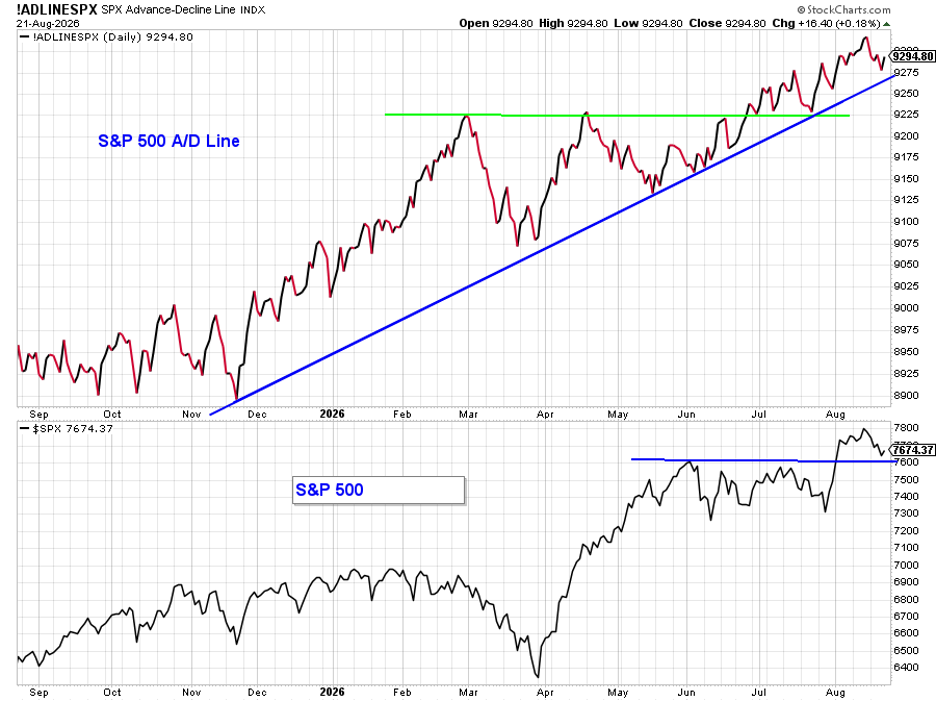
The S&P 500 recently was down about 2% from its recent highs, but as long as it remains above the early June peak, we expect this bull move to continue. At the same time, the S&P 500’s advance/decline line remains firmly in an uptrend. This is a measure of breadth, and should it continue to trend higher, it is another healthy bullish clue. If these two areas should give way, then more trouble could be on the horizon. But for now, we believe the summer rally looks likely to continue.
$40 Trillion in Debt
The US hit a new milestone, as the government now owes more than $40 trillion in debt. Debt hit $20 trillion just nine years ago, and it isn’t just a Republican or Democratic thing: President Biden added about $9.5 trillion in four years, while President Trump added $7.8 trillion in his first term and another $4.0 trillion so far less than two years into his second term. We now pay an annualized $1.1 trillion of interest on our debt, more than the Defense Department’s budget.

Like many, we aren’t big fans of this, but for decades, we’ve seen calls that higher debt would lead to a major catastrophe, and it simply hasn’t happened yet. The reality is that balance sheets for corporate America and consumers remain quite healthy overall, and these matter more to how our economy and stock market will do.
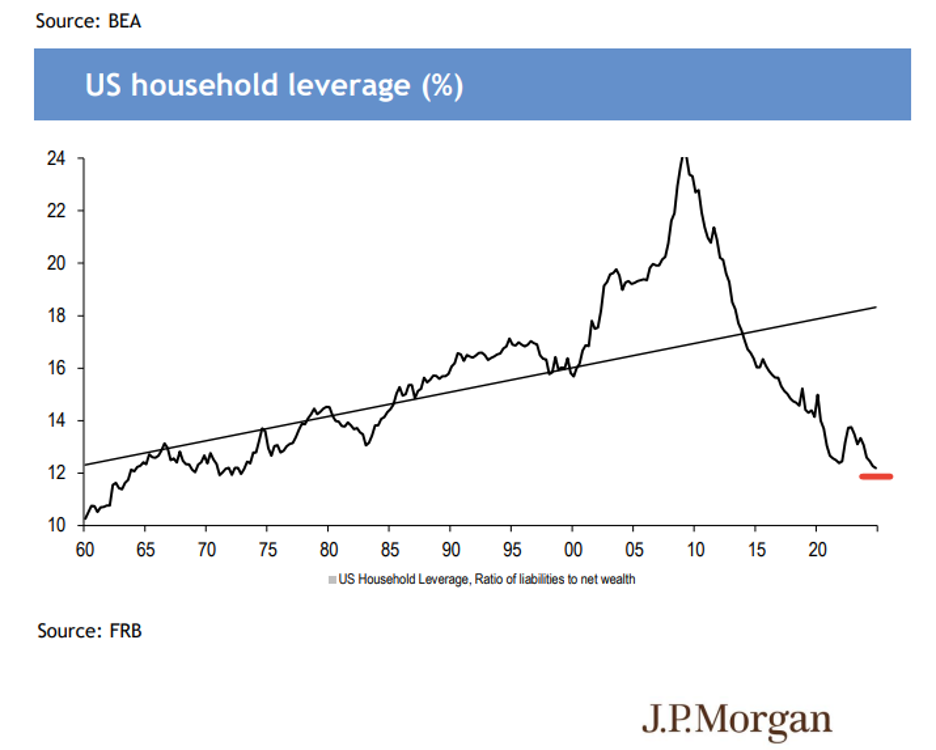
A good way to show this is to look at how much households owe (liabilities) and compare it to overall net wealth. Sure, liabilities are higher than they’ve ever been, but so is net wealth. The chart below from J.P. Morgan shows household leverage is actually in the best shape it has been in since the early 1970s.
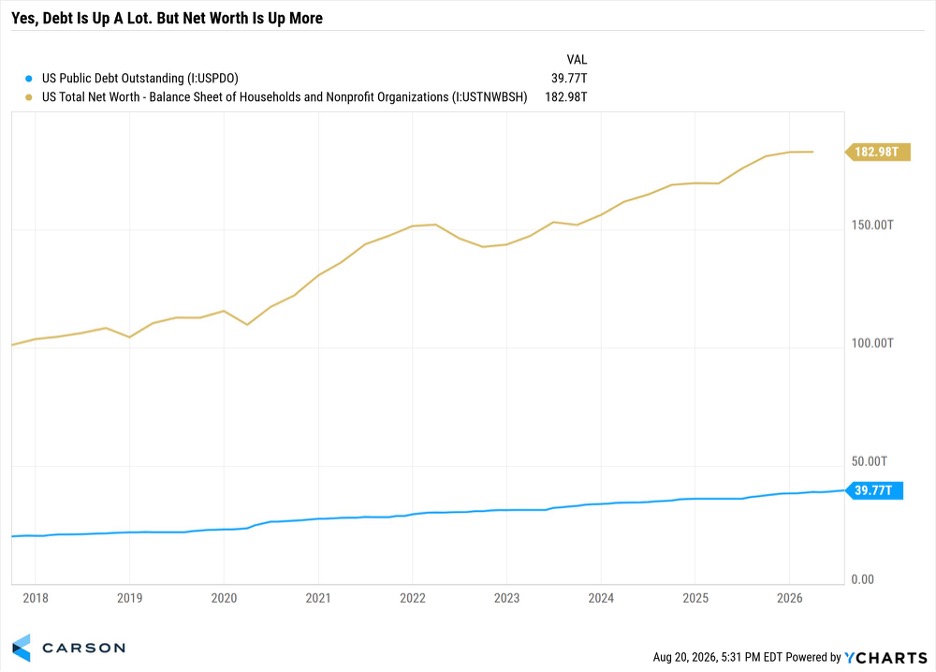
Another way to show this: US debt has doubled from $20 trillion to $40 trillion over the past nine years, but household net wealth has increased from $101 trillion to $183 trillion over the same period.
The AI Buildout Needs a Lot of Money—Enter Debt
We’ve written a lot about how tech capex spending by the hyperscalers (large companies that run computing infrastructure at enormous scale) is set to run around 2.5-3% of GDP in 2026 and 2027. What’s striking is how fast the estimate keeps moving higher. Coming into this year, 2026 capex was projected at $515 billion. After Q2 earnings, it’s $775 billion, and 2027 is above $1 trillion.
The question is where the money comes from. Up until now, these companies had enormous free cash flow to fund the buildout. That’s no longer true, while chipmaker free cash flow is surging.
- Free cash flow for the five largest hyperscalers peaked near $400 billion at the end of 2024 and is on track to be roughly $21 billion by year end.
- The major semiconductor companies on the other side of the trade are running toward $353 billion.
Capex is eating the cash flow of the buyers and depositing it with the sellers. Therein lies the circularity we’ve discussed since last year, including in our full-year 2026 Outlook. What’s new is the leading AI chipmaker finding ways to finance the spending beyond simply forking over billions to AI labs. Below, we take a bit of a deep dive into how this is evolving. A warning that the details are complex, but it’s worth reading through it just to get a broad sense of what’s going on.
A New Central Bank of Tech Spending?
The leading AI chipmaker made big news on August 10, announcing a memorandum of understanding with six major Wall Street players—one large bank plus five private capital firms and asset managers— to set up “independent compute financing platforms” and raise more than $500 billion of third-party capital for the buildout.
Here’s how it works: The platforms lend to the operators building AI capacity—the “neoclouds,” non-traditional cloud companies that build systems solely to train and run AI. The borrowers then spend the proceeds mostly on chips. The debt sits in special purpose vehicles, and here’s the important piece: the debt is collateralized by a combination of GPUs and offtake contracts, commitments to buy compute in the future.
An analogy from commodity finance helps explain how this works. A mine or LNG plant can get financed on a future purchase commitment from a creditworthy buyer, especially if the contract is take-or-pay (the buyer must pay even if they don’t take delivery). Here, the output is compute, and the lender’s collateral is the chips plus the contract in a bankruptcy-remote vehicle. The financing rests more on the customer contract than on the chips. That means the credit rating isn’t really about the chipmaker, and it isn’t really about the chips, nor the cloud operator. It’s about whoever is buying the compute.
The chipmaker’s own role is deliberately limited. Its CEO described compute as “an investable infrastructure asset” and said the company may provide financing support of “up to 25% of an opportunity.” It’s essentially a residual-value guarantee, deal by deal, with a ceiling around $125 billion. It kicks in only after other recovery steps, such as re-leasing capacity or selling the chips. In effect, the chipmaker acts as lender of last resort to its own ecosystem. A few caveats:
- Nothing is committed. These memorandums of understanding (MOUs) are non-binding.
- None of the six partners has disclosed a dollar allocation, and no project has been named.
- The $125 billion is a ceiling on agreements that don’t exist yet. Only about $3.5 billion of lease guarantees is contracted today.
Keep the context in mind. Just weeks earlier, the same company was reported to be in talks to backstop $250 billion for a major AI lab to lease compute from an energy developer’s Ohio hub, plus another $350 billion of chip purchase financing. Its five-year credit default swaps hit 0.82% in late July, versus about half that earlier in the year. That’s classic vendor financing: When a chipmaker backstops a customer’s lease directly, it isn’t just providing capital, it’s manufacturing a sale that perhaps wouldn’t clear otherwise—creating demand with its own balance sheet.
Handing the underwriting to six independent managers changes that. In theory, they screen deals on the merits and can decline what the chipmaker might have waved through to protect a customer relationship. It transfers tail risk off the chipmaker’s balance sheet, which is why credit markets liked it: Credit default swap protection eased to 0.73% and the company’s bonds rallied. The stock fell 2.4% on August 10 when the news broke, but it’s up 16.2% from its July 29 low, versus 5.5% for the S&P 500.
Debt Is the Answer, and It’s Already Underway
Going back to the earlier question, the answer to more financing is clearly debt. And this isn’t a 2027 story.
- Incremental debt funded roughly 9% of hyperscaler capex in fiscal 2024, and about 32% on a trailing basis by mid-2026.
- US data center debt issuance roughly doubled to about $182 billion in 2025.
The template already exists. One large neocloud operator’s $8.5 billion delayed-draw facility from March sits in a bankruptcy-remote vehicle, secured by GPUs and customer contracts, rated A3, priced at about 5.9% fixed, and maturing in 2032. The operator itself is junk-rated and its own notes come at 9%. But the collateral is sold into the vehicle in a true sale, so it isn’t part of the estate if the operator files for bankruptcy. That’s how you get investment-grade paper out of a junk-rated borrower.
It isn’t the chips doing that work, either. A GPU is poor collateral for long-dated debt: The dominant chipmaker ships a new architecture roughly every year, the competitive life of a generation is two to three years, and hyperscalers depreciate the hardware over five to six years. Three-year resale estimates range from “retains 50-70%” (industry data providers) to “down more than 70%” (the bears). Nobody really knows, because the secondary market is young.
What makes the debt investment grade is the take-or-pay contract, held outside the borrower’s estate, with front-loaded amortization so principal comes back inside the contract term and residual value never has to be tested. That condition is already slipping. The same operator’s newest $2.6 billion facility carries roughly a five-year maturity against customer contracts averaging about three years. Whatever is outstanding past year three isn’t backed by an offtake contract at all. It’s a bet on GPU residual value, which is the one thing nobody can price.
If this all sounds so complex it’s a little scary, it is. So the question that matters is who the ultimate payer is.
- If it’s one of the largest hyperscalers, it’s probably fine. The paper is a claim on some of the strongest balance sheets in the world.
- If it’s an AI lab, it’s dicier. The labs have to keep raising capital to honor existing commitments, making this credit deferral rather than credit substitution.
- One particular large software-and-cloud company that’s part of this is in between: About half of its $638 billion backlog is attributed to a single AI lab. Its fiscal 2026 free cash flow was negative $23.7 billion, and S&P cut its rating to BBB- in July (one notch above high-yield).
None of these mechanics are new. It’s the same machinery behind commercial mortgage-backed securities, aircraft financing, and energy projects. What’s remarkable is the speed: GPU-backed lending was happening at double-digit yields as recently as 2023, and we’re now at 5.9% investment grade.
Actual Spending Is Even Larger Than the Headline Numbers
Bigger still is one hyperscaler’s marquee data center project: $27 billion of vehicle debt rated A+, priced at 6.58%, amortizing to 2049, with a single large bond manager taking about $18 billion. The hyperscaler keeps 20% of the joint venture, and the debt stays off its balance sheet.
That’s the real story on scale. Big tech’s AI spending is much larger than headline capex because trillions of dollars of future commitments sit off balance sheets. The Wall Street Journal reported that nine major tech companies have roughly $3 trillion of off-balance-sheet obligations, mostly tied to AI infrastructure, versus about $600 billion of reported capex over the past year—roughly three times their combined lease liabilities and long-term debt. It comes from two places:
- Leases that haven’t started yet, about $1.2 trillion, which typically stay off balance sheet until the lease begins. One company alone disclosed $347 billion, with the marquee data center project above the leading example.
- Purchase commitments, about $1.9 trillion, largely for chips, data center equipment, and energy. These aren’t recorded until the goods are delivered.
Another hyperscaler is the standout, with commitments jumping to $811 billion from $332 billion three months earlier, some extending to 2054.
This Is Financial Engineering, and That’s Why It Matters
To be clear, none of this means the buildout is fake or the paper is bad. Where the offtaker is a hyperscaler on a firm take-or-pay contract and the loan amortizes inside the contract term, the structure is legitimate and the debt will likely perform. But the character of the buildout has changed. When the marginal dollar of capex is debt-funded, capex becomes sensitive to credit conditions in a way it never was when funded from operating cash flow.
Financing the boom more cheaply, which is exactly what these platforms are designed to do, also makes future demand more sensitive to credit volatility. That’s a trade-off, not a free lunch.
It also means two enormous claimants are now competing for the same pool of capital. The other one is a federal government that has already run a $1.8 trillion deficit 10 months into the fiscal year and is paying the highest yields at 30-year auctions in 25 years—a big reason the 30-year Treasury yield sits at levels last seen in 2007. Add an AI buildout near 2.8% of GDP that increasingly needs to borrow, and a higher cost of capital shouldn’t surprise anyone.
This is no longer a story about one company, or even one sector. The AI buildout can keep going, but it no longer runs on free cash flow alone. As debt replaces cash, the bond market gets a vote. Watch the credit market, not just the chip orders. Equity investors get to be patient about when AI pays off. Bondholders have a maturity date.
S&P 500 — A capitalization-weighted index of 500 stocks designed to measure performance of the broad domestic economy through changes in the aggregate market value of 500 stocks representing all major industries.
The NASDAQ 100 Index is a stock index of the 100 largest companies by market capitalization traded on NASDAQ Stock Market. The NASDAQ 100 Index includes publicly traded companies from most sectors in the global economy, the major exception being financial services.
The views stated in this letter are not necessarily the opinion of Cetera Wealth Services LLC and should not be construed directly or indirectly as an offer to buy or sell any securities mentioned herein. Investors cannot invest directly in indexes. The performance of any index is not indicative of the performance of any investment and does not take into account the effects of inflation and the fees and expenses associated with investing.
A diversified portfolio does not assure a profit or protect against loss in a declining market.
All investing involves risk, including the possible loss of principal. There is no assurance that any investment strategy will be successful. This information is from sources believed to be reliable, but Cetera Wealth Services, LLC cannot guarantee or represent that it is accurate or complete.
9090626.1-0826-C
